Decide whether exfoliation belongs in your routine before choosing a tool
Exfoliation is optional, and a scrub, brush and acid product are not simply different strengths of the same task. The decision should account for your skin, current products and any treatment. A useful review can end with choosing a gentle appropriate method, asking a professional or leaving exfoliation out.
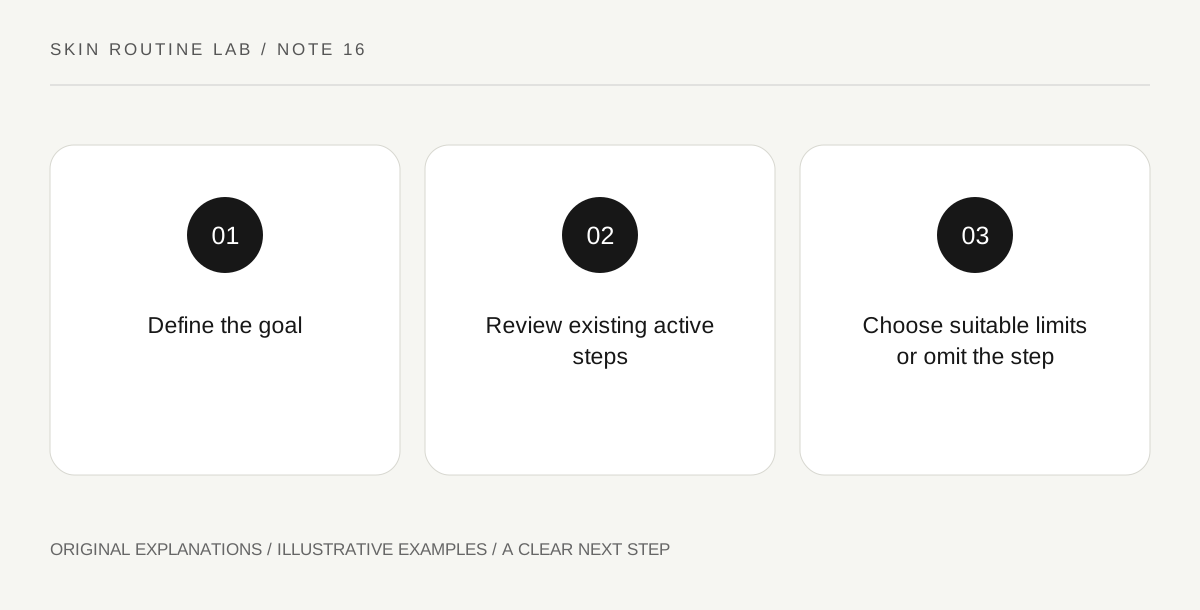
Original explanatory diagram. Read the full method and limitations below.
Name the goal without a pore myth
Describe what you hope to change, such as the feel of a rough cosmetic surface, and distinguish that from acne, a rash or a lesion needing assessment. Exfoliation does not open and close pores like a door or remove an imaginary layer of toxins. AAD explains that methods include mechanical and chemical approaches and that not every method suits every skin type. If you cannot explain the goal without repeating an advertisement, pause before buying. A routine does not become incomplete because it lacks a scrub. Comfort and appropriate care are more useful than checking every possible product category.
Review the products already doing related work
Include cleansers, leave-on acids, retinoids and prescription products in the review. An item may exfoliate even when its front label emphasizes brightness or smoothness. Adding a scrub can create overlapping effects that are easy to miss when products are counted only as separate steps. Ask your dermatologist how optional exfoliation fits with treatment or sensitive skin. Do not suspend prescribed care to make space for a trend. AAD cautions about irritation and the needs of skin prone to dark spots. Your own history matters more than a generic schedule copied from someone with different products and skin.
Choose a method only within clear limits
If exfoliation is appropriate, follow the actual method and directions. Mechanical pressure, frequency and chemical strength are not variables to increase together. Avoid exfoliating sunburned, broken or irritated skin. Do not use a household acid or an abrasive cleaning tool because it seems similar to a cosmetic product. A sensation of burning is not proof of better results. If directions are unclear, resolve them before use. This article does not provide a universal frequency, acid concentration or combination plan. Those choices depend on the specific product and individual circumstances, especially when a clinical condition is involved.
Judge the routine by comfort and purpose
Review whether the step serves the original cosmetic goal without persistent irritation. A smoother feeling immediately after rubbing does not establish long-term benefit. If the skin becomes uncomfortable, stop the suspected optional product and seek advice as appropriate. Do not answer dryness by adding another active ingredient, then another heavy layer to conceal the discomfort. Keep the routine understandable enough that you can describe it to a professional. A decision to use no exfoliant, or a less frequent appropriate method, can be a complete and practical outcome. The aim is suitable care rather than maximum product activity.
Temporary texture, lighting and makeup residue can change your impression of the surface. Return to the original goal before deciding that a rough-feeling day requires another exfoliation product or a more forceful technique.
An illustrative overlap review
Dana considers a facial brush while already using a leave-on acid and a prescribed product. She lists all three roles and asks her dermatologist whether exfoliation is appropriate. She does not add the brush while waiting for advice. The review may result in a simpler routine rather than a new tool.
Practical checks
Optional checkboxes save only in this browser.
Questions that come up
Is daily exfoliation necessary for everyone?
No. Need and suitability vary, and some people may be better served without an exfoliation step. Follow appropriate product and professional guidance.
Does burning mean the product is working?
Do not use burning as a success signal. Stop a suspected irritating cosmetic and obtain appropriate advice, especially for significant or persistent symptoms.
References and scope
These sources support the factual background. Examples and exercises are original illustrative teaching material. References do not imply endorsement.
- AAD: How to Safely Exfoliate at Home — Exfoliation methods, irritation risks and existing routine considerations.