Before decanting a cosmetic, ask what information and protection you lose
A smaller jar can make a bag lighter while losing a readable label, a clean dispensing system or the product's identity. Decanting is a handling decision, not merely a packing trick. The most useful review asks whether the smaller format preserves appropriate use and whether transferring is necessary at all.
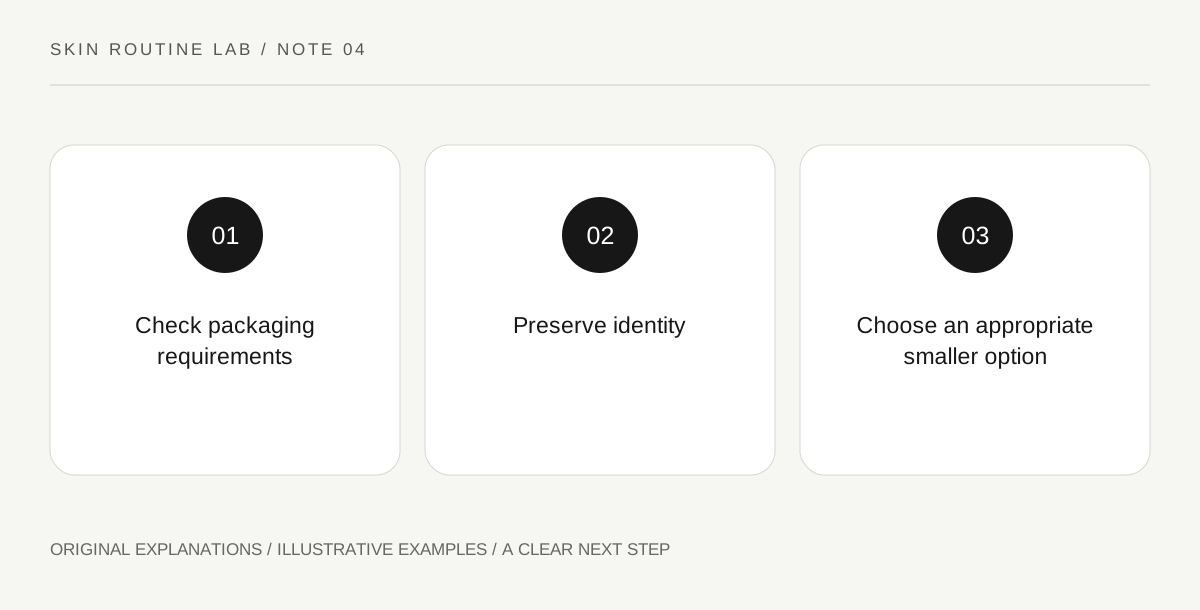
Original explanatory diagram. Read the full method and limitations below.
Start with the job of the original package
A pump, tube or sealed container can limit handling and deliver a product in a way the manufacturer intended. Opening it to fill another pot changes that arrangement. FDA explains that contamination can arise through handling and that preservatives have a role in product safety. A container that looks clean is not proof of microbiological suitability. Check whether the manufacturer permits transfer and whether a smaller original package is available. Do not dismantle packaging or dilute a product just to make it flow into a travel bottle. Some products have storage or packaging requirements that a generic container will not preserve.
Keep identity and directions attached
If transfer is appropriate for the specific product, retain the exact name, intended area, directions and relevant date information. An unmarked white cream is difficult to distinguish from another white cream in a shared bathroom. Include enough information to avoid using a body item near the eyes or confusing a cosmetic with a prescribed product. Keep original packaging accessible, perhaps through a private readable photograph, while recognizing that a photo does not solve a storage problem. Never rely only on the color of a lid. A companion or helper should be able to identify the item without guessing your personal color code.
Avoid mixing remnants
Do not top up an old container with a different formula or combine leftovers to save space. That obscures identity and changes the product as supplied. Clean and dry handling requirements depend on the container and product, and a casual rinse is not a universal preparation method. If the suitability of the container cannot be established, use an original package or a different packing arrangement. The small amount left behind is not a reason to invent a formula. Keep products away from household chemicals and food containers that could cause confusion, especially in a family bag or shared accommodation.
Choose the smallest change that solves the problem
Sometimes the simplest option is carrying the original tube, leaving an optional product at home or buying a manufacturer-filled smaller size. Compare actual weight and volume rather than assuming every decant saves much. A lightly packed routine can still include a slightly larger labeled product if that is the usable option. After travel, do not pour unused transferred product back into the original container. Follow appropriate disposal and product guidance. The practical goal is convenient care with clear identity and handling, not a perfectly matching row of miniature jars whose contents and history become uncertain.
A permitted travel-container size does not certify formula compatibility or safe handling. Check transport restrictions separately and keep enough product information to make intended use clear to anyone helping with the bag.
An illustrative overnight bag
Julia considers moving three products into identical pots for one night away. She finds that one original tube is already small and another product is optional. She carries the tube with its label and leaves the extra at home. For the remaining item she checks manufacturer guidance instead of assuming a decorative jar is suitable.
Practical checks
Optional checkboxes save only in this browser.
Questions that come up
Is a rinsed food jar always suitable?
No. A familiar container does not establish compatibility, cleanliness or appropriate dispensing. Prefer the original package when suitability is unclear.
Can I add water to make transfer easier?
Do not dilute a cosmetic. Added water can change the formula and introduce contamination; use it as supplied and directed.
References and scope
These sources support the factual background. Examples and exercises are original illustrative teaching material. References do not imply endorsement.
- FDA: Microbiological Safety and Cosmetics — Contamination risks, product handling and the role of preservatives.