Keep eye makeup inside its intended-use boundaries
A product's color does not tell you whether it belongs near the eyes. Eye-area cosmetics need attention to intended use, condition and application setting. Small shortcuts, such as reviving old mascara with water or applying liner in a moving vehicle, can create risks that a polished result does not justify.
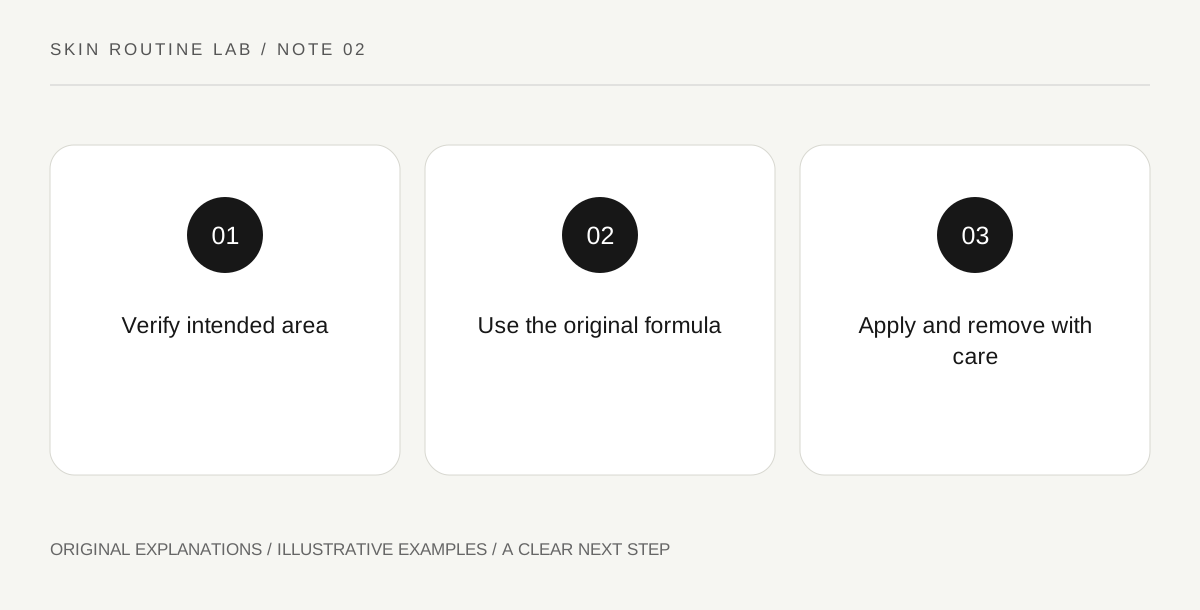
Original explanatory diagram. Read the full method and limitations below.
Read the intended area before the shade name
Check whether the product is specifically intended for the eye area and follow its directions. A lip pencil and an eye pencil may look similar while having different intended uses. Decorative pigments and craft glitter should not be treated as interchangeable with eye cosmetics. Keep the original package or reliable label information so the distinction remains available after purchase. If a set contains several product types, identify them before use rather than assuming every color can be placed anywhere. Ask the manufacturer when the intended use is unclear. A social-media demonstration does not expand a product's labeled use.
Keep the formula as supplied
FDA warns against adding water or saliva to eye makeup. Adding liquid can introduce contamination and alter the preservative system. A mascara that feels dry is not a recipe needing repair, and an old eyeliner should not be mixed with a household liquid to recover its original texture. Keep caps closed and follow storage directions. Do not transfer a formula into an unclean container or combine the remains of different products. A lower-cost replacement or skipping the step is more sensible than treating a nearly empty cosmetic as a project that must be rescued at any cost.
Choose a stationary application setting
Apply eye cosmetics where you can remain still, see what you are doing and place tools securely. Do not use a moving car, bus or train as the setting for a pointed applicator near the eye. A makeup routine that only fits during a commute needs a timing change or a simpler version. Keep hands and applicators clean, avoid sharing and stop using a product that causes irritation. If you have an eye infection or inflammation, follow professional advice and FDA guidance about use and disposal. Do not hide a symptom under more makeup to complete an occasion look.
Plan removal and response to problems
Read how the chosen cosmetics should be removed and use appropriate gentle methods. A difficult-to-remove product does not authorize hard rubbing or a household solvent near the eyes. Keep the remover's own intended use visible too. If pain, vision changes or persistent irritation develops, obtain appropriate medical care rather than experimenting with another cosmetic layer. Keep the product identity and packaging available for the professional or any manufacturer report. A product can appear normal and still be unsuitable for you; equally, one reaction does not establish the diagnosis or mean every eye cosmetic has the same risk.
Keep the cap and applicator together so an open product is not left exposed while you search through a crowded bag. A smaller working collection can make careful handling easier when time is limited.
An illustrative commute decision
Sofia realizes her morning routine depends on applying mascara during a bus journey. She moves that step to a stationary mirror at home and keeps a shorter makeup option for rushed days. When the tube becomes dry, she follows product guidance and replaces it rather than adding water. The change prioritizes a usable routine over finishing every step.
Practical checks
Optional checkboxes save only in this browser.
Questions that come up
Can a lip pencil double as eye liner?
Use products only for their intended areas. Similar texture or color does not establish suitability near the eyes.
Can water restore dry mascara?
Do not add water or saliva. Follow the product's replacement and storage guidance instead of altering the formula.
References and scope
These sources support the factual background. Examples and exercises are original illustrative teaching material. References do not imply endorsement.
- FDA: Eye Cosmetic Safety — Eye-area product use, contamination, sharing and avoiding unsafe application.