Read fragrance language alongside the ingredient list and your own history
Fragrance-free, unscented and natural can sound like versions of the same promise, but they do not answer exactly the same question. A useful label review starts with a known concern and the full product information. Marketing language cannot guarantee that nobody will react or identify the cause of a rash.
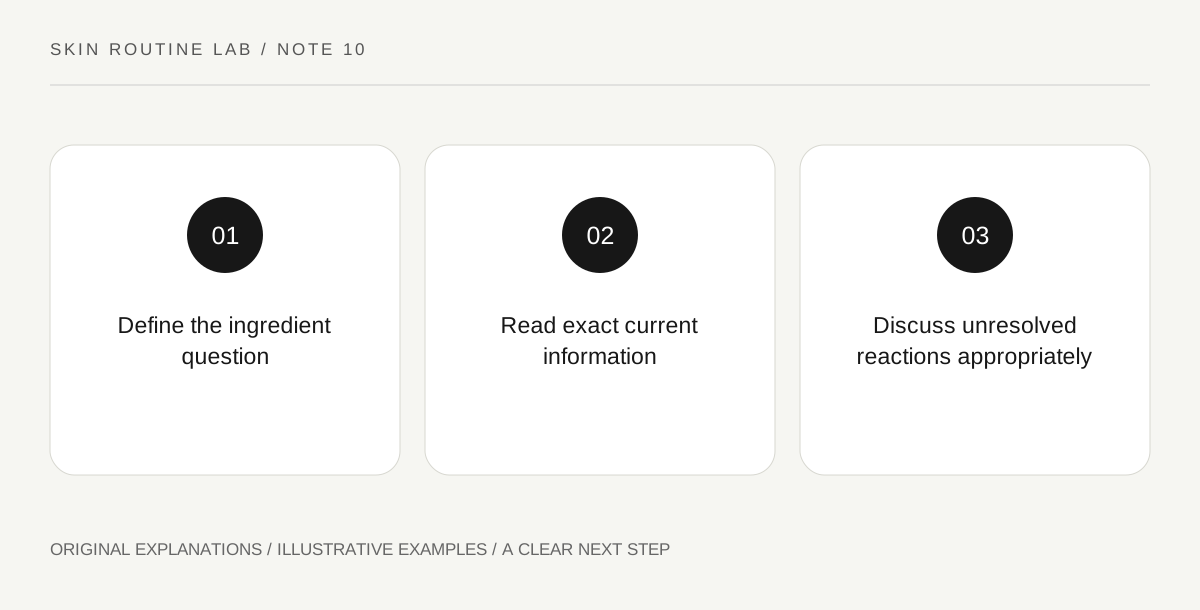
Original explanatory diagram. Read the full method and limitations below.
State the question before comparing labels
Are you avoiding a known allergen identified by a clinician, reducing fragrance exposure because it bothers you or choosing a personal scent preference? Those are different tasks. FDA explains that cosmetic products can contain allergens and that ingredient information matters. If you have a diagnosed allergy, keep the specific professional instructions available rather than replacing them with a broad category such as chemical-free. A product can be free of a familiar scent while still containing an ingredient relevant to you. Conversely, disliking a fragrance does not by itself establish an allergy. Clear wording helps you ask the manufacturer or clinician the right question.
Treat front-label terms as limited information
Fragrance-free and unscented can differ because a product may use ingredients to mask odor. Natural ingredients and essential oils can also cause reactions in some people. Do not assume a botanical illustration establishes universal gentleness. Read the complete ingredient list and any directions, while recognizing that label terminology and disclosure rules vary by jurisdiction. If the information you need is unclear, contact the manufacturer with the exact product identity. Avoid inferring a formula from a retailer's shortened description or from a similarly named item sold in another market. Products and versions can change.
Preserve information after a suspected reaction
If a cosmetic appears to cause irritation, stop using the suspected item and seek appropriate guidance. Keep its name, ingredient information, batch details if available and the timing of use. Describe what happened without declaring the cause. A clinician may decide that evaluation or patch testing is appropriate; consumer experimentation does not replace that process. Do not repeatedly reapply a product to prove a reaction, especially after significant symptoms. Seek urgent help for severe allergic symptoms such as breathing difficulty. A label comparison should make a care conversation easier, not turn a reaction into a home challenge.
Shop with a focused, manageable record
Use the relevant professional avoidance information when available and check the actual current product. A short note of a specific concern is more useful than memorizing an enormous online blacklist. Keep optional purchases modest while the question is unresolved. Do not assume that every product from one brand has the same formula or that a higher price means lower reaction risk. Once you find an appropriate comfortable option, it need not be replaced because a trend uses more reassuring language. The goal is a clear decision based on your needs, reliable information and appropriate advice.
Save the exact spelling of a professionally identified allergen and any alternatives your clinician provides. Recheck a familiar formula when its packaging changes instead of assuming every version carries identical ingredient information.
An illustrative ingredient enquiry
After a clinician identifies a specific allergy, Hana checks a moisturizer's current ingredient list rather than relying on its natural branding. One ingredient description is unclear, so she asks the manufacturer about the exact product version. She keeps the professional avoidance list with her shopping note and does not test a suspected allergen to confirm it herself.
Practical checks
Optional checkboxes save only in this browser.
Questions that come up
Does natural mean allergy-free?
No. Natural or botanical ingredients can cause reactions in some people. Use specific information rather than a universal safety assumption.
Is a home trial the same as clinical patch testing?
No. Clinical testing is a professional process used to investigate particular concerns. Ask a qualified clinician about suspected allergy or persistent reactions.
References and scope
These sources support the factual background. Examples and exercises are original illustrative teaching material. References do not imply endorsement.
- FDA: Allergens in Cosmetics — Allergens, ingredient information and limits of marketing terms.