For diagnosed melasma, connect cosmetic coverage with light protection
Melasma can make a person want coverage today while treatment takes time. Cosmetics and light protection have different roles, and a comfortable plan can account for both. This guide concerns practical questions for someone already discussing melasma with a dermatologist; it does not diagnose facial pigmentation or prescribe a treatment regimen.
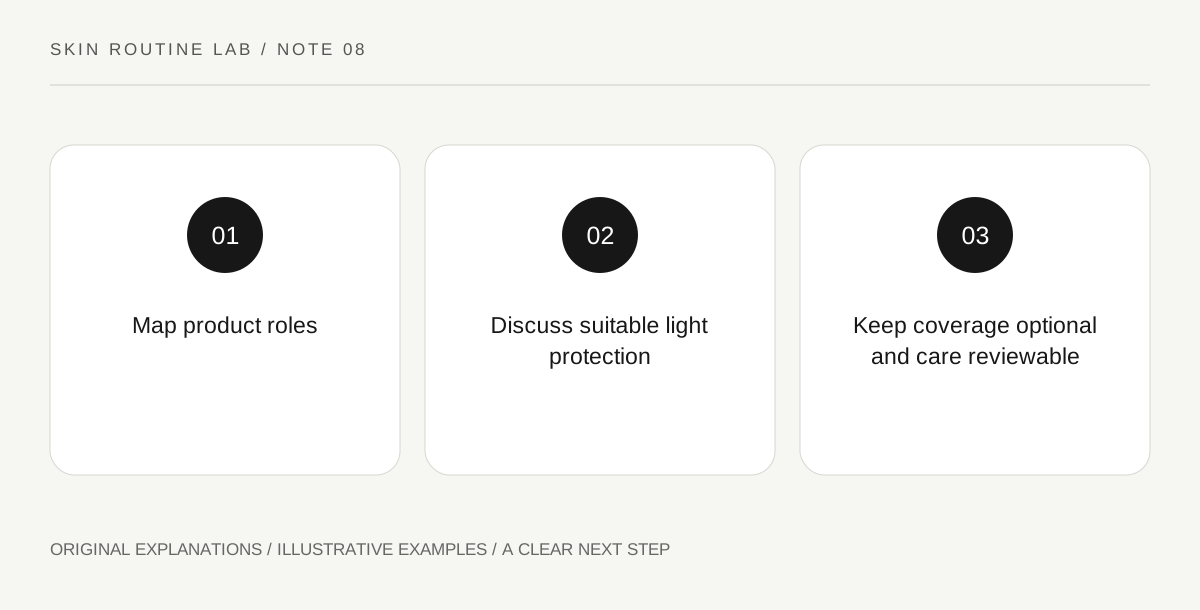
Original explanatory diagram. Read the full method and limitations below.
Clarify the role of each product
Write which item provides sun protection, which provides coverage and which belongs to a clinician-directed treatment plan. A tinted cosmetic may serve more than one role only when its actual label supports that use. AAD explains that melasma can be affected by sunlight and visible light and recommends appropriate protection. Do not infer protection from a beige color alone. Ask your dermatologist how the chosen products fit together, especially if a treatment has specific application instructions. Keeping the roles clear prevents an attractive concealer from silently replacing the protection step or a treatment being used merely as another makeup layer.
Ask about visible-light protection specifically
AAD's melasma self-care guidance discusses tinted sunscreen containing iron oxide as well as broad-spectrum protection. That is a more specific question than asking for the strongest-looking bottle. Consider shade suitability, comfort and whether you can use the product according to directions. A product that is technically relevant but so mismatched that you apply very little may be impractical. Ask about appropriate alternatives and supporting measures such as shade and clothing. This article cannot compare individual formulas or certify that a particular tint provides a measured level of visible-light protection. Use the label and professional guidance for the actual product.
Make coverage a preference rather than a duty
If you want makeup, choose a manageable finish and use suitable personal tools. AAD recognizes cosmetic coverage as an option while melasma care is underway. It is equally reasonable to leave the skin uncovered. Avoid a routine that requires repeated friction, a painful peel or several unfamiliar products just to create a supposedly acceptable surface. Discuss irritation with the dermatologist because burning and stinging are not helpful signs to ignore. A cosmetic goal can be modest: comfortable coverage for a meeting, not complete invisibility in every light or an exact match to a filtered photograph.
Keep long-term expectations realistic
Melasma can persist or recur, and the plan may need review. Ask what improvement means in your situation, when follow-up is appropriate and how to handle changes in pregnancy, medicines or other relevant circumstances. Do not start a prescription ingredient from someone else's routine or use a bleaching mixture without medical guidance. If a product causes a reaction, report it and keep the exact identity available. Review whether the daily arrangement is usable as well as whether the appearance changes. A plan that depends on constant product switching or an unaffordable lineup may need a more practical discussion.
Ask how to maintain the protection step during your actual workday, commute and makeup use. A product-role map is helpful only if the steps remain feasible when you leave the bathroom.
An illustrative product-role map
Tara has a dermatologist-confirmed melasma plan. She lists treatment, protection and optional coverage separately, then asks whether her chosen tinted protection product is appropriate. For work she uses a small amount of concealer where she prefers it, without reducing the protection step to keep the finish thin. Coverage remains her choice.
Practical checks
Optional checkboxes save only in this browser.
Questions that come up
Does any tinted foundation replace sunscreen?
No. Tint alone does not establish the protection provided or the amount needed. Follow the actual product label and dermatology advice.
Must melasma be covered with makeup?
No. Coverage is an optional cosmetic preference. Care and protection can be planned whether or not you choose to wear makeup.
References and scope
These sources support the factual background. Examples and exercises are original illustrative teaching material. References do not imply endorsement.
- AAD: Melasma Self-Care — Sun and visible light protection, gentle products and cosmetic coverage.