For diagnosed rosacea, change handling before adding another corrective layer
With diagnosed rosacea, a routine can become uncomfortable because of rubbing, hot water or too many corrective steps as well as the products themselves. A gentler handling review is a useful conversation with your dermatologist. It supports an existing care plan and does not diagnose redness or replace prescribed treatment.
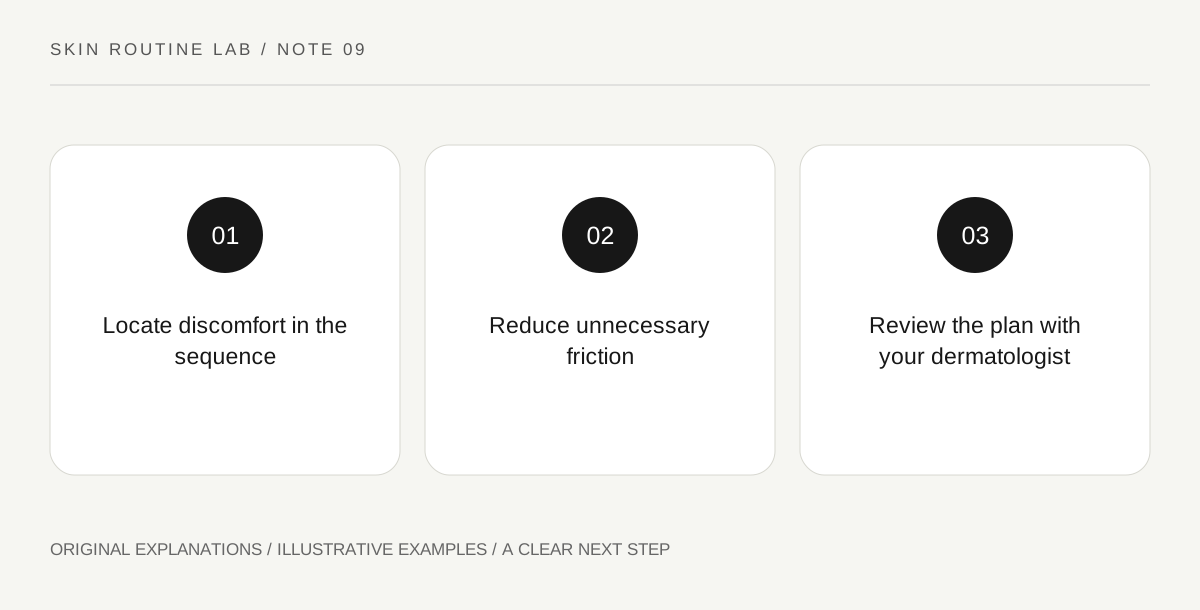
Original explanatory diagram. Read the full method and limitations below.
Observe the moments that provoke discomfort
Describe when stinging or warmth appears: during washing, towel drying, applying makeup or removing it. Keep the product names and water conditions available. Do not assume every uncomfortable moment has the same trigger. AAD notes that rosacea can make skin sensitive and that gentle care matters. A short sequence review can reveal repeated friction that a shopping list misses. If symptoms are persistent, worsening or involve the eyes, seek appropriate professional advice. An online review of technique should not delay assessment or lead you to call every facial redness rosacea without a diagnosis.
Reduce mechanical effort
Use the gentle handling recommended by your dermatologist and product directions. Avoid washcloth scrubbing, rough brushes or rubbing until the skin feels polished. Patting dry gently is different from dragging a towel repeatedly over a sensitive area. A makeup product that requires vigorous removal may be an impractical choice even when its finish looks appealing. Consider a simpler cosmetic option or ask about suitable removal. The aim is not to create a universal routine but to remove unnecessary effort from your own sequence. More friction does not prove greater cleanliness, and discomfort is not evidence that an active product is working.
Keep labels and known triggers specific
AAD recommends gentle, fragrance-free products for rosacea care and notes that some ingredients can irritate. Individual suitability still matters. Bring the complete ingredient information and any known reactions to your clinician rather than relying only on the word sensitive on the front label. Fragrance-free and unscented are not always equivalent descriptions. Avoid replacing every product simultaneously because one seems problematic. A focused discussion can preserve the useful parts of an established routine while clarifying an uncertain item. Do not change prescribed treatment based on a cosmetic ingredient list or a friend's account of their own trigger.
Make the routine easy to report and revise
Write down the sequence you actually follow, including makeup, removers and occasional masks or exfoliants. Explain which step is difficult and how it affects daily use. Ask what to stop, continue or change within the professional plan, and how to respond if symptoms recur. If a recommended arrangement is costly or hard to obtain, say so. A usable routine should account for practical access as well as an ideal product list. Keep review focused on comfort, care instructions and observed changes, without promising that a gentler towel technique alone will control a chronic condition.
Count handling across the whole day: makeup touch-ups, repeated wiping and evening removal can each contribute to contact with sensitive skin. A sequence review should include these moments rather than only the morning product list.
An illustrative removal review
Elise follows a prescribed rosacea plan but rubs hard to remove long-wear makeup. She describes that step to her dermatologist and asks about a gentler cosmetic and removal arrangement. She keeps the treatment instructions intact while adjusting the optional makeup choice. A handling change supports care without becoming a claimed cure.
Practical checks
Optional checkboxes save only in this browser.
Questions that come up
Does redness alone prove rosacea?
No. Several conditions can cause facial redness or irritation. Seek assessment rather than assigning a diagnosis from an online description.
Should prescribed treatment be stopped when simplifying makeup?
Do not change prescribed care without advice. Ask the treating professional how cosmetic changes fit the existing plan.
References and scope
These sources support the factual background. Examples and exercises are original illustrative teaching material. References do not imply endorsement.
- AAD: Seven Rosacea Skin-Care Tips — Gentle handling and skincare as part of a clinician-directed rosacea plan.